If you run a warehouse or industrial facility anywhere in the LA area, you already know that electricity isn’t a line item you can set and forget. Conveyor belts, forklift charging stations, compressors, cold storage units, and high-bay lighting all draw from the same electrical backbone — and when that backbone was designed for a different era of operations, something eventually gives. Usually at the worst possible moment, during peak shift, with a full loading dock waiting.
At DIGICO, we’ve spent 17 years providing commercial wiring services for industrial and warehouse facilities across Los Angeles, and one pattern shows up again and again: the facilities that avoid costly downtime are the ones that treat electrical infrastructure as a long-term investment, not an afterthought bolted on after every new piece of equipment arrives. This guide breaks down what actually goes into a reliable industrial electrical installation — from load planning to lighting to code compliance — so you know exactly what to ask for and what to expect from a qualified electrical contractor.
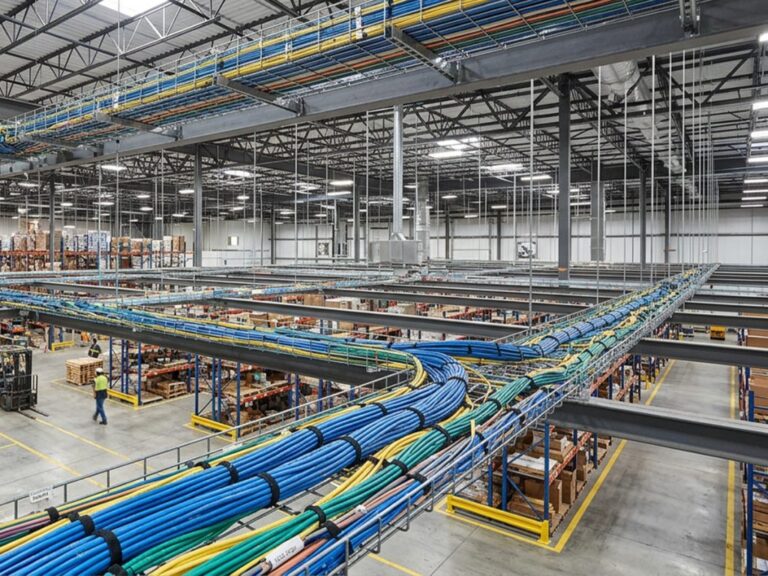
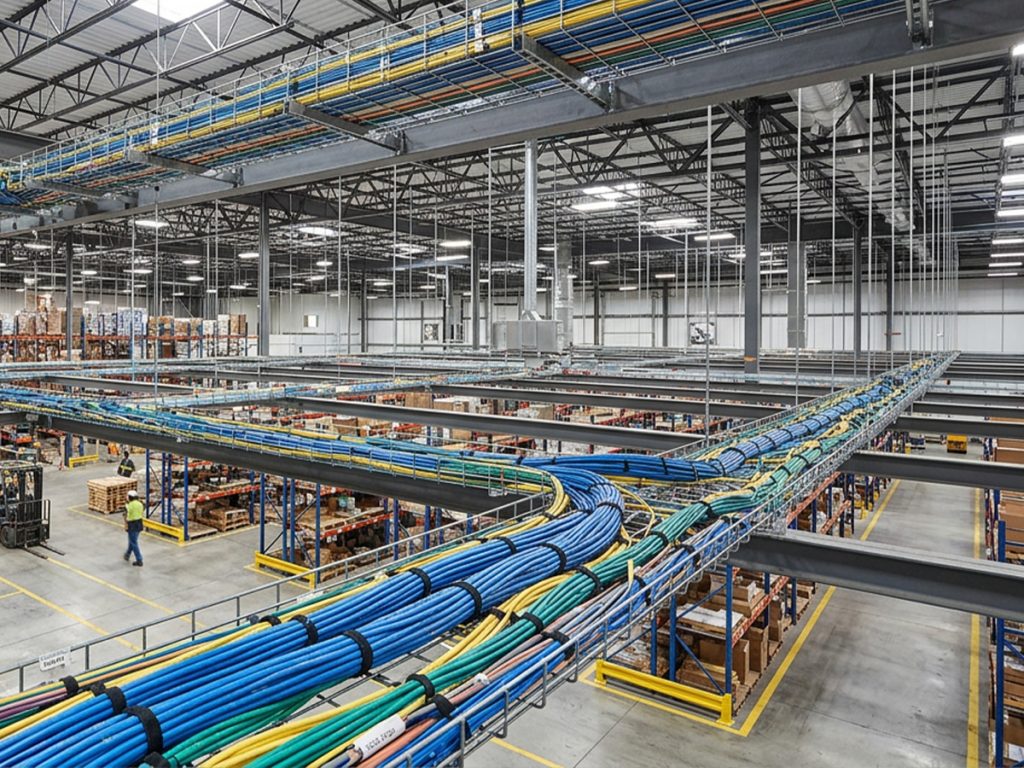
Modern warehouse projects involve much more than electrical panels and power distribution. Security systems, structured cabling, fiber optics, access control, Wi-Fi infrastructure, and warehouse management systems often need to be installed alongside electrical work. Coordinating both power and low-voltage systems under a single contractor helps avoid scheduling conflicts, reduces disruption, and creates infrastructure that’s easier to expand as your operation grows.
In this guide:
- Why warehouse and industrial electrical systems require different planning than standard commercial buildings
- What a properly engineered industrial electrical installation includes, from panel sizing to grounding
- How warehouse lighting upgrades improve efficiency – and how available utility rebates may reduce project costs
- How power and low-voltage systems (security, data, fiber) fit together in a single wiring project
- What LADBS permitting and California code compliance require before work begins
- The wiring problems we see most often in older LA facilities, and how they get fixed
- What working with DIGICO actually looks like, from site assessment to inspection sign-off
Why Industrial and Warehouse Wiring Is Different from Standard Commercial Buildings
A retail storefront and a 100,000-square-foot distribution warehouse are not wired the same way, and treating them as if they were is where a lot of problems start.
Industrial facilities typically run:
- High-load, motor-driven equipment — conveyor systems, compressors, packaging machinery, forklift charging stations
- Three-phase power for larger motors and equipment, which standard single-phase residential-grade panels aren’t built to handle
- Tall ceilings and open floor plans, which change how lighting circuits, fixture mounting, and conduit runs need to be planned
- Environmental stress on materials — dust, temperature swings, moisture, and in some cases combustible materials, all of which determine what type of conduit and cable jacketing is appropriate
That last point matters more than most facility managers expect. The National Electrical Code (NEC), maintained by the National Fire Protection Association, classifies certain industrial environments — anywhere flammable vapors, combustible dust, or fibers may be present — as hazardous locations that require sealed fittings, specific wiring methods, and explosion-proof equipment. Skipping this classification isn’t just a compliance gap; it’s a genuine fire and life-safety risk. Before a licensed electrician runs a single wire in your facility, they should be assessing its occupancy and hazard classification, not assuming a standard commercial approach will do.
Core Components of a Reliable Industrial Electrical Installation
Load Calculation and Panel Sizing
The single most common failure point we see in older LA warehouses is an undersized electrical panel. A facility adds a new packaging line, a couple of extra compressors, or an EV charging station for its delivery fleet — and nobody circles back to recalculate whether the existing service and panel can actually support the added draw. The result is nuisance breaker trips at best, and overheated equipment or an electrical fire hazard at worst.
A properly engineered industrial electrical installation starts with an honest load calculation: what’s running today, what equipment is realistically coming in the next five to ten years, and how much reserve capacity the service and panel need to carry. This is not a step to shortcut, even when it means a larger upfront investment in panel capacity than a business initially budgeted for.
Conduit and Wiring Materials for Industrial Environments
Standard residential-grade wiring simply wasn’t built for warehouse floor conditions. Depending on the environment, an experienced electrical contractor typically selects from:
- THHN/THWN conductors for general dry or wet industrial applications
- MC (metal-clad) cable for faster, protected runs through exposed industrial areas
- Rigid conduit or EMT, chosen based on exposure to impact, moisture, or corrosive materials on the production floor
Getting this selection wrong rarely causes an immediate failure. It tends to show up two or three years later as insulation breakdown, corrosion at connection points, or a wiring method that fails inspection the next time the space is renovated or expanded.
Grounding and Bonding for Safety
Warehouses are full of large metal structures — racking systems, machinery frames, rooftop HVAC units — and every one of them needs to be properly grounded and bonded. OSHA’s general industry electrical standard, 29 CFR 1910 Subpart S, sets the design safety requirements for workplace electrical systems, including grounding, and outlines what employers are legally obligated to follow to protect employees from electrical hazards (OSHA, 29 CFR 1910 Subpart S). Improper grounding is one of those problems that stays invisible right up until there’s an electrical fault — at which point it’s the difference between a tripped breaker and a serious injury.
Warehouse Lighting Installation — Balancing Efficiency and Visibility
Lighting is where a lot of warehouse operators are leaving real money on the table. Lighting can account for a significant share of a warehouse’s total electricity use, particularly in facilities with long operating hours and high ceilings. Because high-bay fixtures typically represent the largest portion of that lighting load, upgrading them to LED systems often delivers one of the fastest payback periods among warehouse electrical improvements.
A well-planned warehouse lighting installation typically includes:
- LED high-bay fixtures replacing older metal halide or high-pressure sodium systems. According to the U.S. Department of Energy, most projected U.S. lighting energy savings by 2035 are expected to come from wider adoption of LED lighting in commercial and industrial buildings, as well as outdoor lighting applications, where operating hours and light output are typically highest. DOE also notes that continued improvements in lighting efficiency, controls, and connected lighting systems could deliver even greater cumulative electricity savings by 2035.
- Zone-specific foot-candle targets — loading docks, storage aisles, pick zones, and office or packing areas each have different visibility requirements, and a lighting design should reflect that instead of applying one blanket fixture spec across the whole facility
- Occupancy sensors and zoned controls in low-traffic storage aisles, so fixtures aren’t running at full output in a corridor nobody has walked down in twenty minutes
Beyond the utility bill, better lighting has a direct safety payoff: fewer shadowed corners near racking, more reliable visibility around forklift traffic, and less eye strain on staff working long shifts under aging or flickering fixtures.
Utility Rebates Can Significantly Reduce Upgrade Costs
One factor many warehouse owners overlook is that lighting upgrades may qualify for utility incentive programs. Depending on the utility provider and project scope, commercial customers may be eligible for rebates on qualifying LED fixtures, lighting controls, occupancy sensors, and other energy-efficiency improvements.
In the Los Angeles area, warehouse operators should review current incentive programs offered by:
- Los Angeles Department of Water and Power (LADWP) for customers within its service territory;
- Southern California Edison (SCE) for facilities served by SCE;
- California statewide energy-efficiency programs, where applicable.
Program requirements, incentive amounts, and eligible equipment change periodically, so rebate opportunities should always be verified before a project begins. For larger warehouse retrofits, available incentives can materially reduce the upfront cost of converting from legacy metal halide or high-pressure sodium fixtures to modern LED systems.
Beyond Power: Data, Security, and Connectivity Wiring for Modern Warehouses
Power isn’t the only wiring a modern warehouse depends on. Warehouse management systems, barcode scanners, security cameras, and networked automation equipment all run on a separate layer of infrastructure — and it’s worth planning for at the same time as your electrical work, not as an afterthought once the panels are already in place.
If your facility is adding a WMS rollout, access control, or a camera system, it’s almost always more efficient to coordinate low-voltage wiring and cabling alongside your electrical project rather than running it as a separate job later, since both trades often share the same conduit paths and ceiling access. The same applies to structured data wiring and installation for office areas, workstations, and networked equipment on the floor — retrofitting data drops after racking and equipment are already installed is far more disruptive than planning for them upfront.
For larger facilities, or ones spread across multiple buildings on the same property, fiber optic cabling and installation is often the more reliable choice over standard copper networking. Fiber holds signal quality over longer distances and isn’t affected by the electrical interference that’s common near industrial machinery and high-voltage equipment — a real consideration in a facility full of motors and compressors.
Industrial Lighting Solutions for Specialized Spaces
Not every part of an industrial facility needs the same fixture, and this is where a generic lighting retrofit falls short of a true industrial lighting solutions approach tailored to how each zone is actually used:
- Cold storage and refrigerated warehouses need fixtures rated for low-temperature operation and moisture exposure — standard LED drivers can fail prematurely in these conditions if they aren’t properly rated for it
- Hazardous or classified zones, such as paint booths or chemical storage rooms, require explosion-proof or vapor-tight fixtures that meet NEC hazardous location requirements
- Outdoor yards and loading docks need lighting that supports both site security and safe nighttime loading operations — as much a liability consideration as an operational one
This is where hands-on experience matters more than a fixture catalog. Choosing the wrong lighting for a specialized zone isn’t just inefficient — it can create a real safety and code violation that surfaces the next time your facility is inspected.
Code Compliance and Permitting in Los Angeles
Any electrical work beyond minor repairs in an LA warehouse or industrial building needs to go through the Los Angeles Department of Building and Safety (LADBS). Electrical permits are generally required for panel upgrades, new circuits, service changes, and installations involving equipment subject to the California Energy Code, along with several other categories LADBS lays out directly on its own site.
Layered on top of local permitting, California’s Title 24 energy code sets lighting power density and control requirements that directly shape how a warehouse lighting installation gets designed — one more reason an off-the-shelf lighting plan that would pass inspection in another state often doesn’t clear plan check in California without adjustment.
Working with a licensed, C-10 certified electrical contractor isn’t a box-checking exercise. It’s what keeps your facility legally protected, keeps your insurance coverage valid, and keeps a plan check from stalling your project for weeks over avoidable documentation errors.
Common Wiring Problems in Older LA Warehouses (and How to Fix Them)
A lot of industrial and warehouse space in the LA area was built decades ago, long before today’s equipment loads existed. The problems we run into most often:
Aging aluminum wiring. Common in buildings from the 1960s and ’70s, aluminum wiring is more prone to loose connections and overheating at junctions than modern copper. It isn’t always an immediate hazard, but it warrants professional evaluation rather than being ignored during a renovation or tenant improvement.
Overloaded circuits from years of “just add one more machine.” Equipment gets added incrementally over years, and nobody circles back to verify the panel and circuits were sized for the cumulative load. The fix is a proper load audit and, in many cases, a panel upgrade before the next piece of equipment goes in.
No dedicated circuits for modern machinery. Newer equipment — especially anything with sensitive electronics or variable-frequency drives — needs its own dedicated circuit rather than sharing a line with general-purpose outlets, where voltage fluctuations from other equipment can cause premature failures.
One of the most common situations we encounter is facilities that gradually add production equipment without recalculating service capacity. By the time nuisance breaker trips begin, the electrical system is often operating much closer to its practical limit than management realizes.
What to Expect When You Hire DIGICO for Commercial Wiring Services
Our process for warehouse and industrial projects generally follows four stages:
- Site assessment — walking the facility, reviewing existing panels, wiring conditions, and current equipment loads
- Load calculation and design — sizing the system not just for today’s equipment, but with realistic headroom for growth over the next several years
- Installation — using materials rated for your specific environment, whether that’s a dry office space or a dust-heavy production floor
- Inspection and sign-off — coordinating directly with LADBS so your project clears plan check the first time, without delays that cost you operational days
The goal on every project is the same: minimal disruption to your operations, full code compliance, and a system built to handle what your facility actually needs today — not just what it needed when the building went up.
If your warehouse or industrial facility is overdue for an electrical assessment — whether that’s aging panels, inconsistent lighting, or equipment that has outgrown your original wiring — DIGICO’s team is ready to help. Reach out for a site assessment and find out what your facility actually needs to run safely and efficiently for the next decade, not just the next quarter.
FAQ
How much does warehouse electrical wiring cost in Los Angeles?
Project costs depend on the scope of work, but typical ranges in the Los Angeles market are:
- LED high-bay lighting retrofit: approximately $250-$700 per fixture installed, depending on mounting height, fixture output, and controls.
- Panel upgrade: roughly $3,000-$10,000+, depending on amperage and existing infrastructure.
- Service upgrade for larger industrial loads: often starts around $10,000 and can exceed $30,000 when utility coordination and new service equipment are required.
Every facility is different, so a site assessment is still the only way to produce an accurate proposal, but these ranges provide a realistic starting point for budgeting.
Do I need a permit for warehouse lighting installation in LA?
In most cases, yes. LADBS generally requires permits for lighting systems and electrical devices subject to the California Energy Code, along with most panel and circuit work tied to the installation.
How often should industrial wiring be inspected?
There’s no single universal timeline, but any facility with wiring older than 20-25 years, recent equipment additions, or a history of tripped breakers should schedule a professional load audit rather than waiting for a failure to force the issue.
What type of lighting is best for high-ceiling warehouses?
LED high-bay fixtures are the standard for ceilings in the 20-foot-plus range, delivering higher output per watt and a substantially longer service life than legacy metal halide or high-pressure sodium fixtures.