Choosing between cat6 vs cat7 is one of the most common decisions property owners face when planning a new wired network in Los Angeles. In most cases, this question comes up not because people need the absolute fastest specification available, but because they want a system that will stay stable, scalable, and reliable for years without constant upgrades.
At DIGICO, we see this conversation daily during site evaluations in homes, offices, and commercial buildings across LA. What often surprises clients is that the “best” cable is not always the highest category. The right choice depends on how the space is used, how many devices are connected, and how the network is expected to grow over time.
In this article, we’ll break down cat6 ethernet cable installation and Cat7 systems in practical terms, based on real installation experience rather than theoretical specifications. The goal is to help you understand where Cat6 is more than enough, where Cat7 may actually be useful, and how to avoid overbuilding infrastructure that your environment does not require.
What Is Cat6 Cabling and How Is It Installed?
Cat6 cabling is currently the most widely used standard in structured cabling systems across residential and commercial properties in Los Angeles. It supports up to 250 MHz bandwidth and can deliver speeds up to 10 Gbps over shorter distances, depending on installation quality and network design.
In real-world applications, cat6 structured cabling is typically chosen because it provides a strong balance between performance and cost efficiency. It supports modern internet usage without introducing unnecessary complexity, which makes it ideal for most homes and small businesses.
We regularly install Cat6 systems in environments such as residential home ethernet installation projects, small offices, coworking spaces, and security system networks. In each of these cases, the goal is not just speed, but consistency across all connected devices.
A proper cat6 ethernet cable installation always includes structured planning rather than simple point-to-point wiring. This usually involves running riser cable between floors where needed, terminating lines into a centralized patch panel, and completing ethernet wall jack installation in each designated location. Every line is then tested to ensure it performs within expected standards.
From experience, the difference between a basic installation and a properly structured system becomes noticeable over time. A well-designed Cat6 network continues to perform consistently even as more devices are added, which is one of the main reasons it remains the default recommendation for most projects.
What Is Cat7 Cabling – And Is It Worth It?
Cat7 cabling is often positioned as a higher-performance alternative, offering up to 600 MHz bandwidth and full S/FTP shielding for maximum interference protection. On paper, this sounds like a significant upgrade over Cat6, especially in environments with potential electrical noise.
However, in practical applications, Cat7 is rarely necessary outside of specialized infrastructure. According to structured cabling standards, most commercial and residential environments do not require shielding beyond Cat6A unless there are specific interference conditions or enterprise-level demands.
In real projects across Los Angeles, Cat7 is typically reserved for data centers, industrial systems, and high-density enterprise networks. These environments require maximum shielding and signal isolation due to heavy electrical activity and critical uptime requirements.
For most property owners, Cat7 does not translate into noticeable everyday performance improvements. Internet speed is usually limited by service plans, routers, and internal network design rather than cable category alone. This is why many clients who initially search for a network cable installer near me ultimately end up choosing Cat6 after a proper consultation.
Cat6 vs Cat7: Side-by-Side Comparison
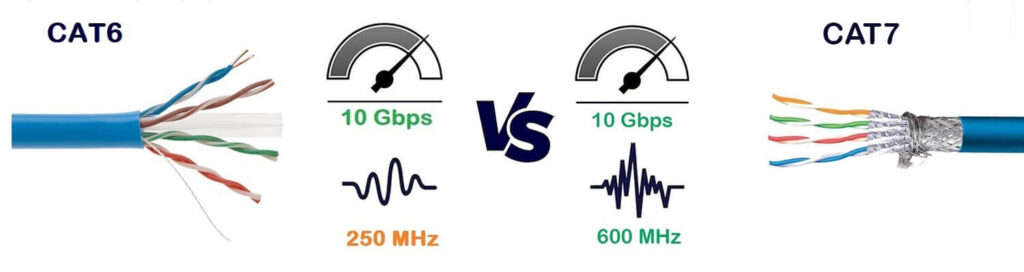
| Parameter | Cat6 | Cat7 |
| Frequency | 250 MHz | 600 MHz |
| Speed | up to 10 Gbps | up to 10 Gbps |
| Shielding | UTP / STP | S/FTP (fully shielded) |
| Distance | 55–100 m | 100 m |
| Best for | Homes, offices, SMB | Enterprise, data centers |
When comparing cat6 vs cat7 speed in real environments, the difference is often minimal unless the network is specifically designed to take advantage of higher shielding and enterprise-grade infrastructure.
In most cases we handle, performance issues are not caused by cable category but by installation quality, poor termination, or lack of structured design.
What About Cat5e? Is It Still Relevant in Los Angeles?
Many older properties in Los Angeles still rely on Cat5e cabling, and in some situations, it continues to function adequately for basic internet usage. However, as network demands increase, its limitations become more noticeable.
Cat5e is typically sufficient for light browsing and single-device usage, but it struggles in environments with multiple simultaneous users, streaming devices, and smart home systems.
This is why cat5e installation service upgrades to Cat6 remain one of the most common requests we handle. In most upgrade scenarios, replacing Cat5e with Cat6 immediately improves stability and reduces network congestion, especially in multi-room setups.
Which Category Is Right for Your Los Angeles Property?
Selecting the right cabling system is less about specifications and more about understanding how your space operates on a daily basis.
When we evaluate properties for structured installations, we consider how many devices will be connected in each area, how the space is distributed, and whether there are plans for expansion such as additional workstations, security systems, or smart home upgrades.
For most residential and commercial environments in Los Angeles, Cat6 remains the most practical and scalable option. It integrates well into structured systems, supports modern bandwidth needs, and avoids unnecessary cost increases.
Cat7 is only recommended in specific cases where shielding requirements or enterprise infrastructure standards clearly justify its use.
How Much Does Cat6 vs Cat7 Installation Cost in Los Angeles?
Installation cost is influenced far more by building structure and complexity than by cable category alone.
Factors that affect pricing include the number of data points required, accessibility of wall and ceiling pathways, use of riser cable between floors, and the total number of ethernet port installation locations.
In most residential and small business projects, cat6 installation cost remains significantly more efficient while still delivering excellent performance. Cat7 installations typically require higher material and labor investment without delivering proportional benefits in everyday usage environments.
Why Professional Installation Matters
Over many years of working with structured networks, one pattern remains consistent: cable performance is only as strong as the installation behind it.
Even high-quality cabling can underperform if termination is inconsistent, routing is poorly planned, or testing is not properly completed. These issues often lead to unstable connections, uneven speeds between rooms, or long-term reliability problems.
A professional ethernet wiring contractor ensures that the entire system functions as a unified infrastructure rather than a collection of individual cable runs. This includes proper design, installation, certification, and long-term scalability planning.
Many clients searching for a network cable installer near me come to us after experiencing issues with DIY or low-quality installations. In most cases, the problem is not the equipment but the lack of structured planning.
Choosing the Right System for Your Property
When evaluating cat6 vs cat7, the most important factor is not which cable has higher specifications, but which one aligns with the actual needs of your environment.
For the majority of homes and businesses in Los Angeles, Cat6 provides the most balanced combination of performance, reliability, and long-term value. It supports modern applications, integrates into structured cabling systems, and avoids unnecessary complexity.
Cat7 remains a specialized solution for enterprise and high-interference environments where its additional shielding is truly required.
At DIGICO, our approach is focused on designing networks based on real usage, not theoretical maximums. Every project we take on is built around stability, scalability, and long-term reliability so clients do not have to revisit their infrastructure every few years.
If you are planning a new installation or upgrading an existing system, our team can help evaluate your property and recommend the most efficient solution for your specific needs in Los Angeles.
FAQ
What is the main difference between Cat6 vs Cat7?
Cat6 supports up to 10 Gbps over shorter distances with less shielding, while Cat7 offers higher frequency (600 MHz) and stronger shielding (S/FTP), mainly for specialized environments.
Is Cat7 better than Cat6 for home installation in Los Angeles?
In most residential and small office cases, Cat6 is sufficient. Cat7 is rarely needed unless there are high interference levels or enterprise-grade requirements.
What is the typical cat6 vs cat7 speed difference in real use?
Both can support up to 10 Gbps under ideal conditions, but Cat6 is usually limited by distance, while Cat7 is designed for more stable performance in noisy environments.
Is Cat7 worth the higher installation cost?
For most properties, no. The additional cost of Cat7 installation does not usually translate into noticeable performance gains outside of specialized networks.
What is Cat6 structured cabling used for?
Cat6 structured cabling is commonly used for home ethernet installation, small businesses, and offices that need stable high-speed connectivity and scalable infrastructure.
Do I need a riser cable for Ethernet installation?
Yes, in multi-floor buildings. A riser cable is often required for vertical runs between floors to meet fire safety and building code requirements.
How much does Cat6 ethernet cable installation cost?
The cost depends on the property size, number of drops, and cable type, but Cat6 is generally more cost-effective than higher-category systems like Cat7.
What does a network cable installer near me do?
A professional installer designs, runs, terminates, and tests Ethernet cabling to ensure stable performance, proper speed, and compliance with building standards.
Can I upgrade from Cat5e to Cat6 without rewiring everything?
In many cases yes. Existing pathways can often be reused, but full performance depends on the condition of current cabling and infrastructure.
When should I choose Cat6 instead of Cat7?
Choose Cat6 for most residential and commercial environments. Cat7 is typically reserved for enterprise, industrial, or high-interference environments.